Most robotics kits are used enthusiastically for about two weekends and then live in a cupboard. That is not because the child lost interest in robots. It is because building the robot was the whole activity, and once it was built there was nothing left to figure out.
This is the honest version of what robotics teaches a child, what the research actually supports, and how to tell the difference between a robot that teaches something and an expensive remote-control car. If you are weighing up a kit or a class, the useful question is not "will my child enjoy this" (they almost certainly will, for a fortnight) but "what will still be there in six months."
What does a child actually learn from robotics?
The real lesson is the feedback loop: a robot senses something, decides what to do, and acts, and your child has to write the deciding part. That loop is the whole of robotics, and it is what separates it from every other kind of building toy.
Everything else follows from that. To make a robot stop before it hits a wall, a child has to understand that a distance sensor returns a number, that the number changes as the robot moves, and that they need to pick a threshold. Pick 5cm and the robot clips the wall. Pick 40cm and it stops in the middle of the room looking foolish. Nobody can tell them the right answer, because it depends on the robot's speed and the floor surface, so they have to test, watch, adjust, and test again.
That is debugging, and robotics teaches it more honestly than a screen does. When code on a screen is wrong, the output is wrong. When code on a robot is wrong, the robot drives into a table leg in front of everybody. Children take physical failure seriously in a way they do not always take a red error message, and the fix is never "read the error", it is "form a theory about why, then test it."
Does robotics actually improve how children think?
Yes, with moderate effects, and it is worth being precise rather than enthusiastic. An umbrella review of computational thinking research published in the Journal of Intelligence in December 2025 pulled together 15 meta-analyses on educational robotics and found consistently moderate effect sizes, with three separate robot-based syntheses reporting g = 0.480, g = 0.558 and g = 0.643.
Moderate is a genuinely good result in education research. It is not a transformation, and any school telling you robotics rewires how a child thinks is selling something.
The same review carries a caveat that matters more than the headline number. It notes that robotics "may be particularly suitable for novice learners and perception-driven tasks, where hands-on interaction enhances engagement but may not fully develop abstract programming logic." In plain terms: robots are an unusually good way in, and a limited way up. A child who only ever does robotics will build strong intuition about sensors and loops, and will still need typed code to go further.
The review is also honest about its own evidence base, scoring the meta-analyses it examined at an average of 10.9 out of 16 on a standard quality checklist, which is moderate rather than strong. Take the direction seriously and the decimal places less so.
Why do so many robotics kits end up in a cupboard?
Because a kit on its own does not teach much, and there is research showing exactly that. A study in Frontiers in Education by Kamini Jaipal-Jamani compared people working through LEGO WeDo robotics activities alone against people working through the same activities with an instructor asking guiding questions.
The self-guided group showed no statistically significant gain in science knowledge. The scaffolded group did, with a large effect size.
Two honest notes on that study before you lean on it. The participants were trainee teachers rather than children, and the groups were small, at 11 and 16 people. So treat it as a strong hint rather than proof about eight-year-olds. But it matches what the umbrella review found independently, which is that results depend heavily on "instructor scaffolding strategies", and it matches what anyone who has watched a child with a robot kit already suspects.
The pattern is always the same. Building the robot is satisfying and finite. The instructions end, the robot works, and the interesting part, which is deciding what the robot should do and why it does not do it yet, never starts unless somebody starts it. That is the whole gap between a kit and a course, and it is worth being clear that the gap is a person, not a better kit.
What is the difference between a robot and a remote-control car?
Sensors. A remote-control car does what you tell it right now; a robot senses something about the world and decides for itself, which means somebody had to write the decision.
This is the single most useful test when you are looking at a product. If your child's only input is steering, they are playing. If their input is a rule, something like "when the light sensor reads below this number, turn left", they are programming. Both are fine, and only one of them teaches anything.
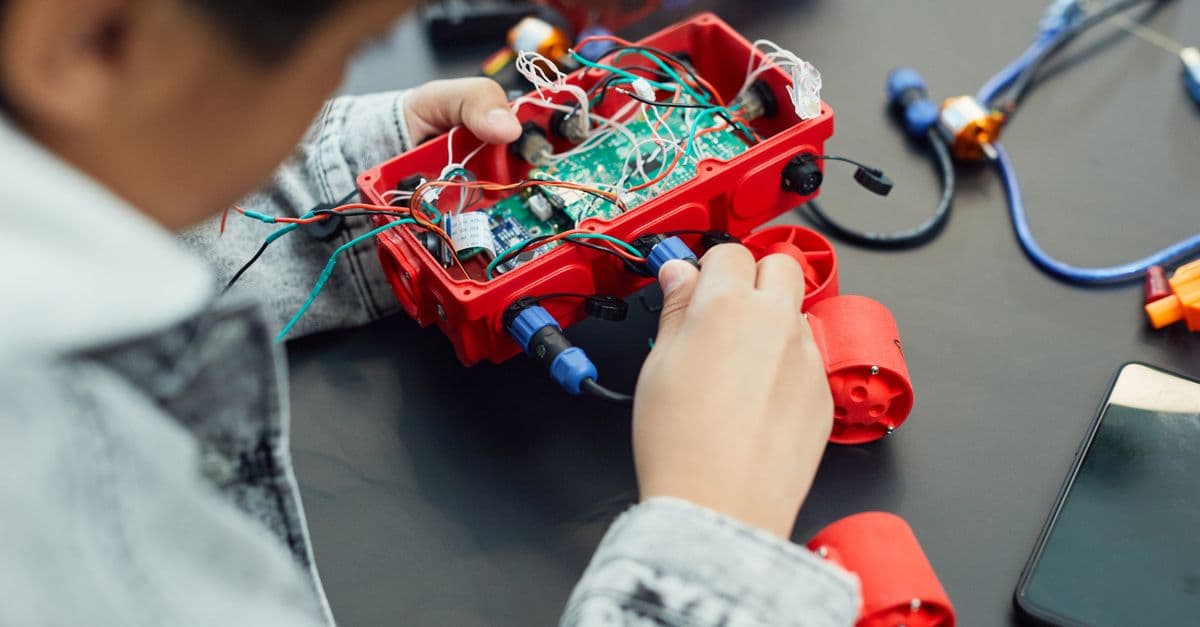
The three parts to look for are sensors, which take a reading, actuators such as motors, which change something in the world, and a controller, which holds the rule connecting them. A robot missing any of the three is a toy with good marketing. Ask what the robot can detect. If the answer is nothing, save your money.
At what age should a child start robotics?
Around seven for the real thing, though the underlying ideas land much earlier. Before that, sequencing games and floor robots that follow a pressed pattern build the same logic without needing a child to read fluently or hold an abstract rule in their head.
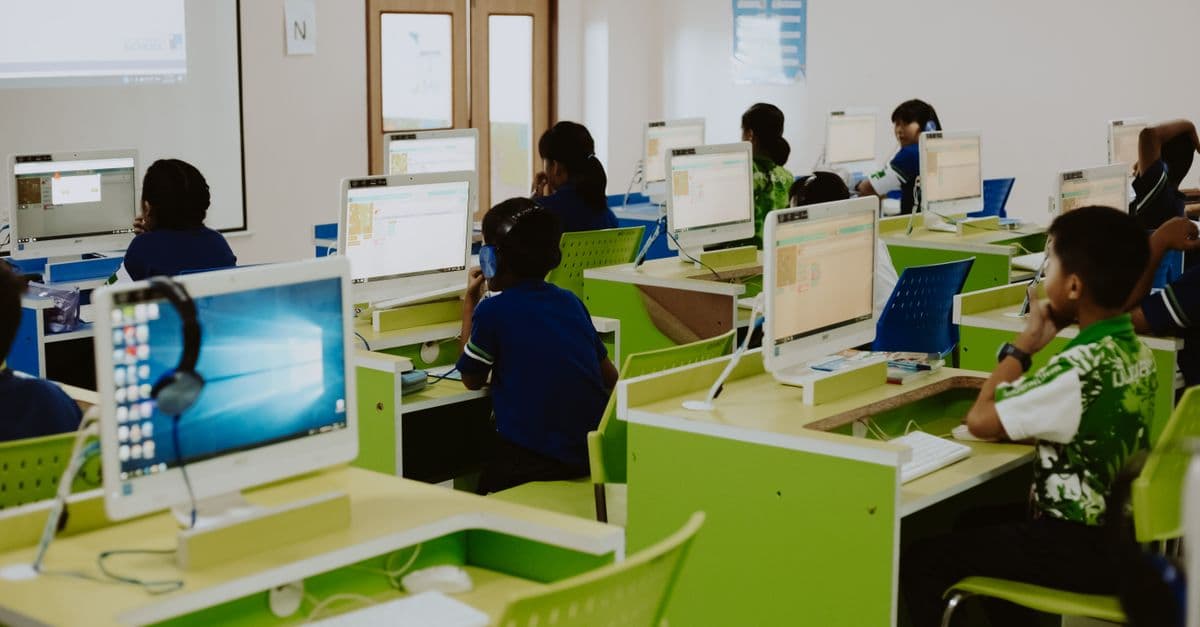
From about seven to eleven, block-based robotics is the sweet spot. Children drag instruction blocks together rather than typing, which means a spelling mistake cannot end the session in tears, and they can concentrate on the actual problem, which is what the robot should do when the sensor reads a particular value. Projects at this stage look like a robot that drives a perfect square, a bot that stops at a red light using a light sensor, or a line follower.
From roughly twelve, typed code becomes the better tool. A teenager can work with GPIO pins, read live sensor values in Python, log data over time, and handle a simplified version of the control problems real engineers face, such as making a line follower move smoothly instead of lurching side to side. That last one is a genuinely hard problem, and a fourteen-year-old who solves it has done something real.
If your child is ten and has never touched any of this, you have not missed anything. Our guide to what age kids should start coding goes into the readiness signals in more detail, and the short version is that curiosity matters far more than the birthday.
Do you need to buy an expensive robotics kit?
No, and the price of the kit is close to the least important variable. What decides whether robotics teaches your child anything is whether somebody is asking them why the robot did that, which no kit includes at any price.
Plenty of the thinking transfers without hardware at all. A child can learn sensors, thresholds, loops and autonomous behavior in a simulator, and the reasoning is identical. The physical robot adds motivation and adds the useful frustration of a world that does not behave exactly like the model, which is worth a lot, but it is an amplifier rather than the source.
If you do buy one, buy the cheapest kit that has real sensors and can be programmed with actual logic, then spend the difference on someone to sit with your child while they use it.
What does robotics look like in a proper course?
It arrives after the fundamentals, not on day one, and it builds toward a robot that makes its own decisions. In both of our tracks, robotics occupies the final two months, once a child already knows loops, conditionals and variables, because those are the things a robot's decision is made of.
The Junior Track is 32 weeks, 64 live classes and 32 projects, with two project options every week so the mentor can match the child. Its robotics phase moves from "what is a robot, and what are sensors and actuators" through motor control, then individual sensors, then combining them, and finishes with obstacle courses and maze solving where the robot has to decide for itself.
The Senior Track is 32 weeks for ages 12 to 16, covering object-oriented programming, file handling, live APIs and robotics with sensors, ending in an autonomous project. Its robotics work is the same shape at a higher level: GPIO and PWM, reading sensor data in Python, multi-sensor integration with data logging, simplified PID control, and a final autonomous navigator.
Every week ends with something built. That is deliberate, and it is the part a kit cannot replicate on its own.
How do you tell if robotics is working for your child?
Watch for whether they change something and then check what happened. A child who adjusts a number, runs the robot, watches carefully and adjusts again has understood the loop, whatever the robot is doing.
The opposite signal is a child who builds exactly what the instructions show, runs the finished program once, and is done. That is assembly, not robotics, and it is the state most kits leave a child in. It is also fixable, usually with one question at the right moment: what would you have to change to make it do the opposite?
If you want to see what the guided version feels like before committing to anything, a free trial class costs nothing and takes no card details. Twenty minutes of watching your own child work through a problem with a mentor will tell you more than any review, including this one.
See your child light up with code
Book a free 1-on-1 trial class with an expert mentor. No credit card, no commitment.
Book a Free Trial Class