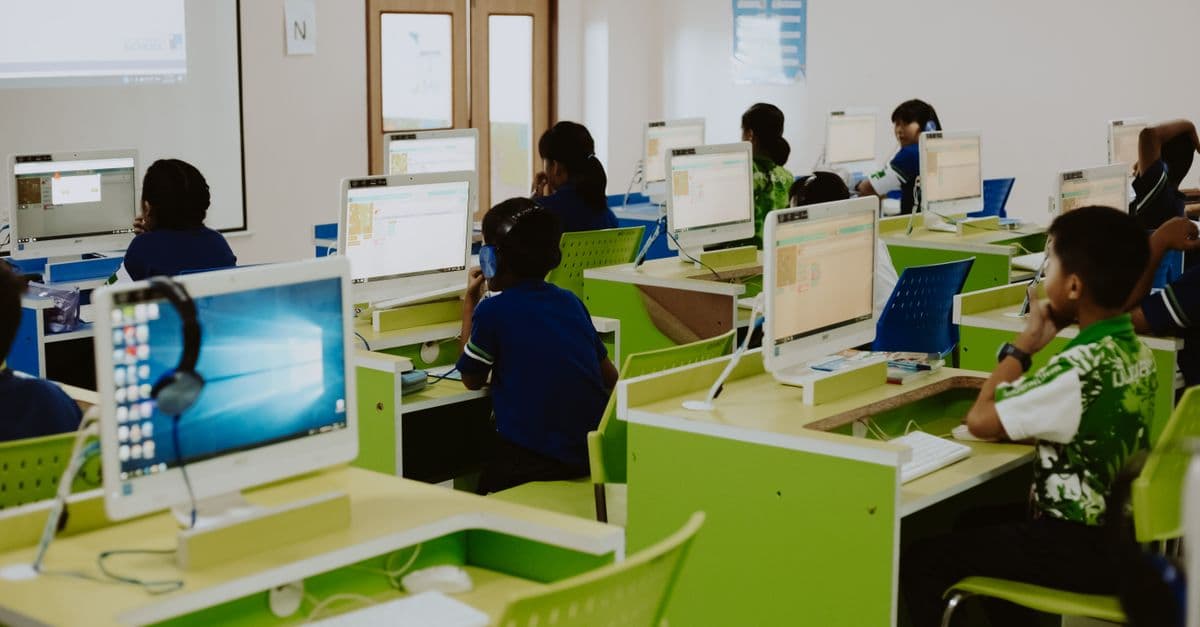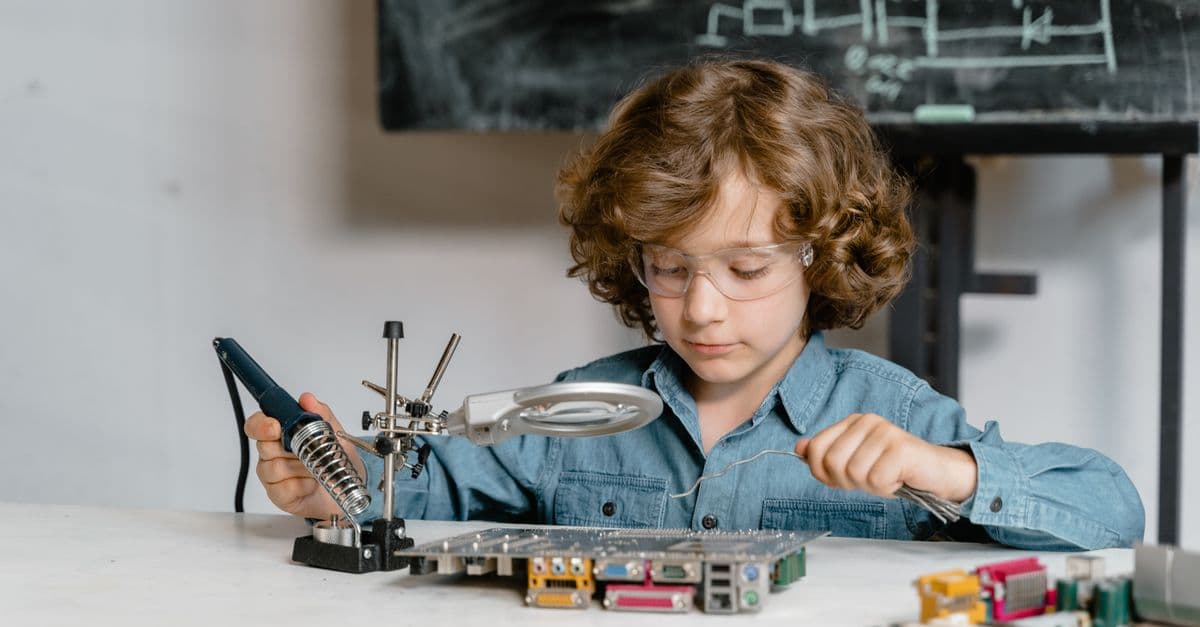
STEM appears on robotics kits, science worksheets, summer camps and school prospectuses, often describing very different things. A label that stretches that far has stopped telling you much.
Here is what the four letters actually are, where the term came from, and the part that matters most for a parent: how much of each letter a child really gets at school. The answer is uneven in a specific way, and it points directly at the gap families end up filling themselves.
What does STEM education actually mean?
Education in four subjects: science, technology, engineering and mathematics, usually with the idea that they are taught together through practical problems rather than as four separate lessons.
That second half is where the term does its real work. Nobody needed a new word for "science and math class." The point of STEM was the combination, a child using math to design something, testing it scientifically, and building it with real tools, which is closer to how those fields are actually practiced.
In practice, the word is used far more loosely than that. A worksheet on the water cycle and a week spent building and programming a robot can both carry the same label, and they are not remotely the same experience for a child.
Where did the term STEM come from?
The US National Science Foundation, in 2001. Before that the same group of subjects went by a less fortunate acronym.
According to Britannica's history of the term, "the STEM acronym was introduced in 2001 by scientific administrators at the U.S. National Science Foundation (NSF)." The foundation "previously used the acronym SMET," and it was the biologist Judith Ramaley, then an assistant director at NSF, who "rearranged the words to form the STEM acronym."
It is a small piece of history, but it is revealing. STEM began as an administrative label for a group of funded fields, not as a teaching method. The teaching ideas attached to it came afterward, which partly explains why the word covers so much.
Why does the STEM label get attached to almost anything?
Because it is vague by design, and vague labels attract marketing. Britannica notes that even educators were unclear on it, citing a study which found that "U.S. educators were unsure of the implications of STEM."
If teachers were unsure what the term demanded of them, a toy manufacturer or a camp brochure has even less reason to be precise. Putting STEM on a product costs nothing and implies something educational, whether or not a child will do any science, technology, engineering or math while using it.
That is why the label on its own is a poor guide. The useful question is always which of the four letters an activity actually involves, and how much of it the child does themselves.
How much of each letter do children actually get at school?
Very unequal amounts. Math gets substantial daily time, science gets much less, and technology and engineering barely appear at all in most elementary classrooms.
The clearest picture comes from the 2018 National Survey of Science and Mathematics Education, a national study by Horizon Research. It found that in kindergarten through third grade, self-contained classes "spent an average of 89 minutes per day on reading instruction and 57 minutes on mathematics instruction, compared to only 18 minutes on science." In grades 4 to 6 the pattern held, with "63 minutes to mathematics" and "27 minutes to science."
So even before technology and engineering come into it, science gets roughly a third of the time math does in the early grades. That is worth knowing on its own, because a school describing itself as strong in STEM may mostly mean strong in math.
Why are technology and engineering the letters schools do least?
Because in most schools they are not subjects at all. They turn up occasionally inside science lessons, and the same national survey shows how occasionally.
The survey found that "the typical science class experiences engineering a few times per year," with only "about a third of science classes" incorporating engineering at least monthly. Coding was rarer still. Depending on grade, between 71 and 89 percent of science classes "never include coding as part of their science instruction."
Access to computing as its own subject is limited too. The survey reports that only 26 percent of elementary schools offered computer science instruction, rising to 38 percent of middle schools and 53 percent of high schools.
Put those together and the shape is clear. The M is taught every day. The S is taught most days, briefly. The T and E are mostly left to chance, which is exactly why they are the letters parents tend to end up providing.
Two honest caveats. These figures are from 2018 and describe schools in the United States, and they are what teachers reported rather than direct observation. They show a national pattern, and your child's school may be well above or below it.
What should a parent look for in a STEM activity?
Whether your child makes something and has to fix it when it does not work. That single test separates real STEM from a label on a box.
An activity that genuinely involves engineering has a problem to solve, a design your child chooses, a test that can fail, and a second attempt. An activity that genuinely involves technology has your child controlling a tool, not just watching one. If a kit can only be assembled one way by following the instructions, it is closer to a jigsaw than to engineering, whatever the packaging says.
It also helps to ask which letter an activity is actually strong in. A robotics club is heavy on engineering and technology. A science fair is usually heavy on science. Neither is better, but knowing which one your child has had tells you which one they have not.
How can you fill the technology and engineering gap at home?
Give your child things to build that can fail, and a way to control them with code. The two letters schools do least are also the two easiest to add at home, and neither needs expensive equipment.
For younger children, the best entry point is a small programmable device, and our guide to the micro:bit covers one that costs little and bridges code and physical objects. For a wider view, our piece on robotics for kids sets out what children actually learn at each age, which is engineering and technology arriving together.
Coding sits underneath both. It is the part of technology a child can practice daily with nothing but a computer, and it trains the problem-solving that engineering depends on, which our guide to computational thinking explains in more detail.
Where does coding fit into STEM?
It is the most practical form of the T, and it connects to the E the moment a child uses it to control something physical. It also draws constantly on the M, which is part of why the letters work better together than apart.
This is how our own courses are built. The Junior Track is 32 weeks, 64 live classes and 32 projects, with two project options every week so the mentor can match the child. The Senior Track is 32 weeks for ages 12 to 16, covering object-oriented programming, file handling, live APIs and robotics with sensors, ending in an autonomous project. That last part is technology and engineering in the same piece of work, which is precisely the combination most schools rarely reach.
If you would like to see what that looks like before deciding anything, a free trial class is one live session with a mentor, no card details and no commitment.
See your child light up with code
Book a free 1-on-1 trial class with an expert mentor. No credit card, no commitment.
Book a Free Trial Class